Your front door handles more abuse than almost any other component of your house. It faces rain, wind, UV exposure, temperature swings, and thousands of open-close cycles every year. So when it’s time to replace one, the decision matters more than most homeowners realize. The choice often comes down to ProVia entry doors vs big box store alternatives: a custom-built product from a specialty manufacturer on one side, and a mass-produced option from a national retailer on the other. Both will keep the rain out on day one. But five, ten, or fifteen years down the road, the differences between these two paths become impossible to ignore. This comparison isn’t about brand loyalty or snobbery. It’s about understanding what you’re actually paying for, what corners get cut when doors are built for volume, and where the real value shows up over the life of your home.
Understanding the Fundamental Differences in Manufacturing
The gap between a ProVia door and a typical big box store door starts long before either product reaches your house. It begins on the factory floor, where fundamentally different manufacturing philosophies produce fundamentally different products. One approach prioritizes precision and individual customization. The other prioritizes speed, scale, and price point. Neither is inherently wrong, but understanding the trade-offs helps you make a decision you won’t regret.
ProVia Custom-Built Precision vs. Big Box Mass Production
ProVia builds doors to order. Each unit is manufactured based on the specific dimensions, finish, glass selection, and hardware configuration a homeowner chooses. This isn’t a marketing gimmick: it means your door is built for your opening, your climate, and your aesthetic preferences. The company operates out of Sugarcreek, Ohio, and maintains tight quality control over every step of the process.
Big box retailers like Home Depot and Lowe’s stock doors from several manufacturers, including Masonite, JELD-WEN, and Therma-Tru. These doors are built in massive quantities to standard sizes. The focus is on hitting price points that appeal to the broadest possible customer base. That means compromises happen in places you might not notice until years later: thinner skins, less insulation, simpler construction methods.
The difference shows up in consistency. A ProVia door goes through over 200 quality checkpoints before it ships. A mass-produced door from a big box store goes through far fewer, because the economics of high-volume manufacturing don’t support that level of individual attention.
Material Thickness and Structural Integrity Standards
Steel entry doors are measured in gauge, and lower numbers mean thicker steel. ProVia uses 20-gauge steel on its Heritage fiberglass and steel doors, while many big box store options use 24-gauge or even 26-gauge steel. That difference might sound minor, but 20-gauge steel is roughly 50% thicker than 24-gauge. You can feel the difference the moment you knock on the door.
Fiberglass doors tell a similar story. ProVia’s fiberglass skins are compression-molded for density and impact resistance. Many retail-grade fiberglass doors use thinner skins that are more prone to cracking or fading after a few years of sun exposure. The internal structure matters too: ProVia uses a solid polyurethane foam core rather than the polystyrene inserts common in budget doors. Polyurethane has roughly twice the insulating value per inch and bonds to the door skins, adding structural rigidity that polystyrene simply can’t match.
Energy Efficiency and Insulation Performance
A door that leaks air is a door that costs you money every single month. The Department of Energy estimates that air infiltration through doors and windows accounts for 25-30% of residential heating and cooling costs. That makes energy performance one of the most important factors in any door purchase, and one of the areas where the gap between ProVia and big box options is widest.
ComforTech Glass Systems and Thermal Barriers
ProVia’s ComforTech glass package is a triple-pane system with two layers of low-E coating and argon gas fill between each pane. The result is a glass unit that performs nearly as well as the insulated door panel itself, which is unusual. Most entry door glass is the weak link in the thermal envelope, but ProVia has engineered their way around that problem.
Standard big box store doors typically come with dual-pane glass and a single low-E coating. Some upgraded options offer argon fill, but triple-pane glass packages are rarely available at retail price points. The difference in U-factor (a measure of heat transfer, where lower is better) is significant. ProVia’s ComforTech glass achieves U-factors as low as 0.18, while standard retail door glass often lands between 0.30 and 0.40. Over a decade of heating and cooling bills, that gap translates into real dollars.
Weatherstripping and Heat Transfer Prevention
The best-insulated door panel in the world won’t help if air leaks around the edges. ProVia uses a dual-bulb weatherstripping system with adjustable hinges that maintain a tight seal as the door ages and settles. The threshold system is also adjustable, which matters because every house shifts slightly over time.
Big box store doors typically come with single-bulb weatherstripping and fixed thresholds. These work fine initially, but after two or three years of use, the weatherstripping compresses and the seal loosens. Replacing weatherstripping is cheap, but most homeowners never do it, so the door slowly becomes less efficient. ProVia’s approach anticipates this problem with more durable materials and adjustable components that let you maintain the seal over time.
The frame construction differs as well. ProVia uses composite frames that won’t rot, warp, or conduct heat the way wood or aluminum frames do. Many retail-grade doors come with wood frames that require regular painting and are vulnerable to moisture damage, especially in climates with significant temperature variation.
Customization Options and Aesthetic Flexibility
A front door is one of the first things people notice about a house. Real estate studies consistently show that an attractive entry door can return 100% or more of its cost in resale value. So the aesthetic dimension isn’t superficial: it’s a financial consideration.
Hand-Applied Stains and Professional Finishes
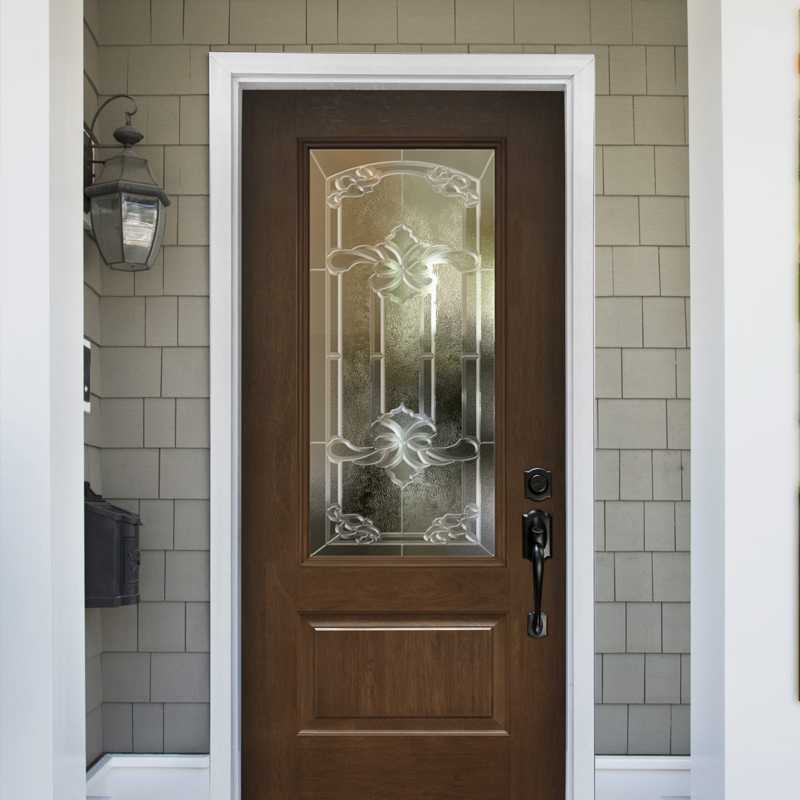
ProVia offers hand-applied stain finishes on their fiberglass doors that genuinely look like real wood. These aren’t factory spray jobs. Each door is stained by hand in multiple layers, creating depth and variation that mimics the natural grain patterns of oak, cherry, or mahogany. The finish is then sealed with a UV-resistant topcoat that ProVia warranties against fading.
Big box store doors offer stain options too, but they’re typically machine-applied or come as pre-stained stock. The results are functional but flat. Side by side, the difference is obvious: a ProVia stained door has the warmth and character of real wood, while a mass-produced stained door looks like what it is, a fiberglass door with a uniform color applied to it.
Paint options follow a similar pattern. ProVia offers factory-applied paint in dozens of colors, applied in controlled conditions that ensure adhesion and durability. Big box doors often arrive primed, leaving the painting to the homeowner or installer, which introduces variability in the final result.
Hardware and Decorative Glass Selections
ProVia’s hardware catalog includes options from Emtek, Schlage, and their own proprietary lines, all pre-fitted to the door before it ships. You can choose from dozens of handle styles, finishes, and deadbolt configurations. The glass selection is equally extensive, with over 100 decorative glass designs ranging from traditional to contemporary, all available with the ComforTech thermal package.
Big box stores offer hardware and glass options, but the selection is narrower and the integration is less precise. You’re typically choosing from whatever is in stock, and the hardware may need to be purchased and installed separately. Decorative glass options at retail tend to cluster around a handful of popular styles, which means your door may end up looking like several others on your street.
Installation Quality and Long-Term Security
Even a perfectly built door can fail if it’s installed poorly. And this is where the comparison between ProVia entry doors and big box store alternatives gets particularly interesting, because the two paths lead to very different installation experiences.
The Risk of Off-the-Shelf Sizing and Shims
ProVia doors are built to your exact rough opening measurements. When a certified ProVia dealer measures your doorway, those dimensions go directly to the factory. The door that arrives fits your opening precisely, minimizing the need for shims, filler strips, and other workarounds that compromise both appearance and performance.
Big box store doors come in standard sizes: 32″, 34″, and 36″ widths with 80″ or 96″ heights. If your opening doesn’t match exactly, and many don’t, the installer has to make up the difference with shims, expanding foam, and trim work. This isn’t a disaster, but it introduces potential failure points. Shims can shift, foam can degrade, and gaps can develop over time. Every shim is a place where air can eventually find its way through.
The installer matters too. ProVia works through a network of certified dealers and installers who are trained specifically on their products. Big box stores use subcontracted installation crews that may or may not have experience with the specific door you purchased.
Reinforced Strike Plates and Locking Mechanisms
Security is a function of the entire door system: the door itself, the frame, the hardware, and how everything connects. ProVia doors come standard with reinforced strike plates that use 3-inch screws anchored into the wall framing, not just the door jamb. This is a critical detail. Most forced entries happen by kicking in the door, and a standard strike plate with short screws is the weakest link.
Many big box store doors come with standard strike plates and 1-inch screws. Upgrading is possible, but it requires the homeowner to know about the issue and take action. ProVia builds the security features in from the start, including multi-point locking systems on many models that engage the door at three or more points along the frame.
The hinges tell a similar story. ProVia uses heavy-duty hinges with non-removable pins on exterior doors. Budget doors sometimes use standard hinges with removable pins, which is a security vulnerability that most homeowners never think about.
Transferable Lifetime Warranties Explained
ProVia offers a transferable limited lifetime warranty that covers the door, frame, glass, and finish against defects in materials and workmanship. The transferable part is important: if you sell your home, the warranty transfers to the new owner, which can be a selling point. ProVia also covers their glass against seal failure and fogging for the life of the original purchaser.
Big box store door warranties vary by manufacturer but typically range from 1 to 10 years, with significant exclusions for finish fading, weatherstripping wear, and glass seal failure. Some warranties are voided if the door isn’t installed by a certified contractor, which creates a catch-22 since many big box installations are done by subcontractors with varying certifications.
Read the fine print on any door warranty. A lifetime warranty that excludes the components most likely to fail isn’t worth much. ProVia’s coverage is notably comprehensive compared to most retail alternatives.
Final Verdict: Choosing the Right Door for Your Home
The comparison between ProVia and big box store doors isn’t really a contest of good versus bad. It’s a question of priorities. If you need a functional door quickly and your budget is genuinely constrained, a retail door will keep the weather out and lock securely. There’s no shame in that choice.
But if you’re investing in a home you plan to keep for years, if curb appeal and energy performance matter to you, and if you’d rather buy one door instead of two or three, ProVia is the stronger long-term investment. The materials are better, the construction is tighter, the energy performance is measurably superior, and the warranty actually covers what matters.
If you’re a Kansas City homeowner weighing your options, the team at Thermal King Windows can walk you through the specifics and help you find the right ProVia configuration for your home and budget. Get a free quote and see what the right door can do for your home’s comfort, security, and value.